Separate stock selection
from macro drift
Take a number to the investment committee, not a narrative.
When the macro contribution is invisible, explaining a quarter comes down to a story — and nobody in the room can tell a macro headwind from a broken process. It is nearly impossible to validate stock-picking skill, or diagnose underperformance, without it.
MFERM gives you the breakdown to report: stock selection here, the environment there, stock by stock and factor by factor, across around 20,000 instruments, updated daily. The same split runs for any period, so it holds up to questions from the committee and from allocators.
An overlay, not a replacement. Our macro models complement the traditional factor model you already run — Axioma, Barra or your own — adding the macro axis those models read only indirectly. They measure rather than forecast: nothing depends on a house view or a call on where rates or oil go next. And they reveal what is actually driving performance, instead of leaving macro lumped into your residual.
Four things long-only managers use it for, drawn from client work across global, regional and pension mandates.
Performance attribution
When the manager asked whether it was macro, the answer was no.
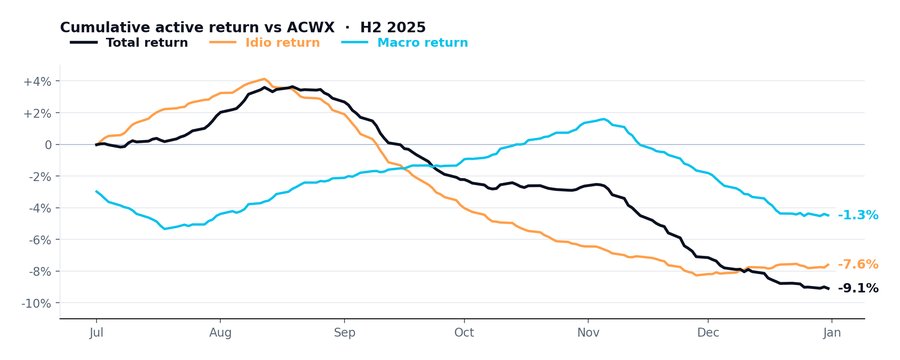
A global long-only equity manager, benchmarked to ACWX and running a bottom-up, EM-heavy book, underperformed by 9.1% over the second half of 2025.
Sixteen per cent of that underperformance was macro. Eighty-four per cent was stock selection. In the third quarter selection cost 3.9% while macro contributed a 1.6% tailwind that partly offset it; in the fourth, macro flipped to a 2.9% headwind and the selection leakage continued.
An answer the manager could act on, rather than one they could only describe.
Performance attribution
Your picks were good. The environment was the drag.
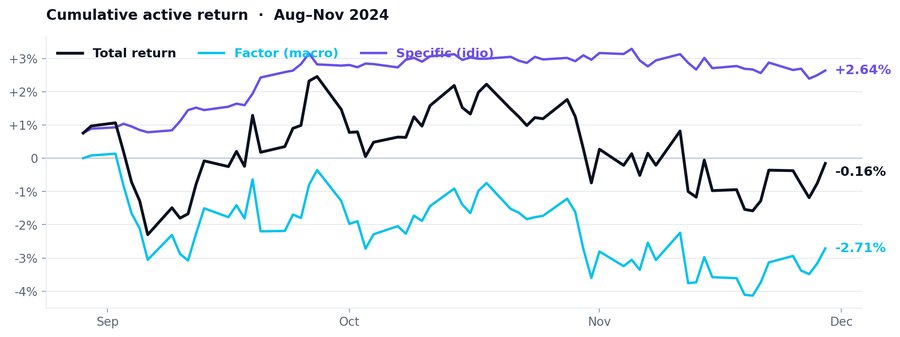
A UK-based long-only manager running roughly 300 names, bottom-up, across a three-month stretch.
The headline was −0.16% and looked forgettable. Decomposed, stock selection added 2.64% while the macro environment took 2.71% away. Ninety-six per cent of forecast risk was factor-driven: the alpha was genuine but invisible at the headline.
The decomposition exonerated the stock-picking and named the macro exposures actually moving the P&L.
Performance attribution
Same portfolio. Four different stories.
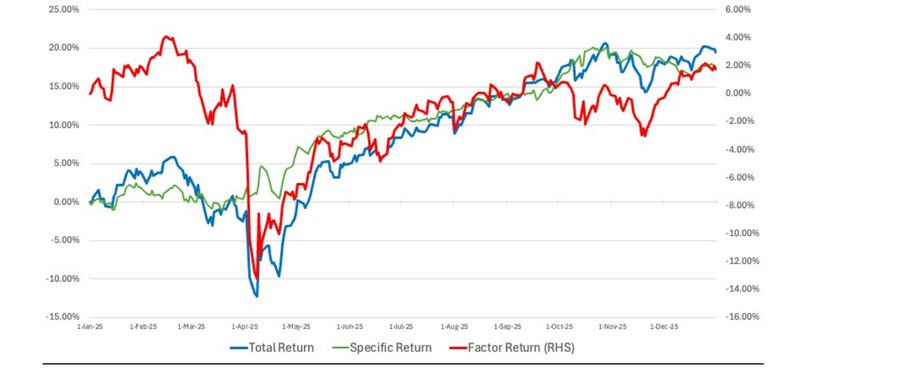
A pension fund's global equity portfolio measured against MSCI ACWI across a full year. One year, read four ways depending on where you stand in it.
The first quarter was macro-driven: a factor return of −3.2% on US credit spreads with idiosyncratic return essentially flat. In April a macro shock took portfolio risk to 23% annualised, almost entirely factor. From the second quarter idiosyncratic return took over, adding 15.7% across three quarters with macro as a tailwind.
Without the decomposition it was simply a good year. With it: a macro escape, three quarters of genuine alpha, and a live read on tail risk into the following year.
Allocation & construction
FTSE 100 or FTSE 250? You are picking a macro regime.
A client asked which UK large-cap exposure to hold. Read through the macro lens it is not really an equity question.
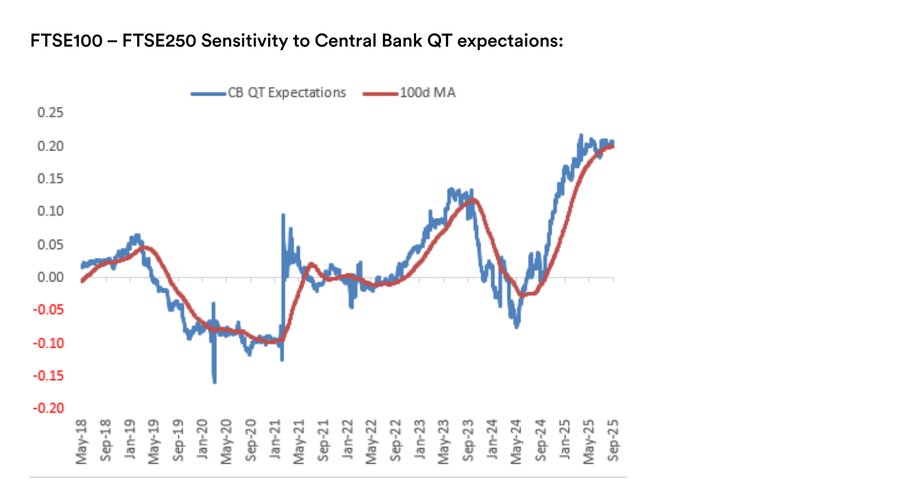
The FTSE 100 is global, defensive and commodity-heavy: long a strong dollar, long metals, long risk aversion, and resilient to quantitative tightening. The FTSE 250 is domestic, cyclical and growth-sensitive: long UK growth, long a stable pound, and vulnerable to tightening and rate volatility.
The sensitivity gap between the two to central-bank tightening sits at historic highs. A UK allocation decision is today, primarily, a bet on whether tightening continues.
Consent needed: these examples come from the confidential use-case deck and describe identifiable client mandates. Anonymised as above they are usable, but each client should sign off before publication. Simulated and modelled results are labelled as such and need the standard risk statement.