Who we help
Is this you?
If you have asked one of these questions and not had a satisfying answer, we built this for you.







Macro Factor Equity Risk Model is our principal solution. It measures the macro inside an equity book at single-stock level, every day: the tilts nobody put on, how much of today's risk is macro rather than idiosyncratic, what the environment took out of a quarter, and how a shock would travel through the book before it lands. Around 20,000 instruments, 4 billion risk data points since 2009, and no forecasting at any point — identify, measure, act, from one model.
Macro Valuation Model answers a different question, across every asset class. It prices each asset against live macro conditions, says whether macro is a headwind or a tailwind today, and flags where price and macro have parted company.
Independent data and analytics — not a research newsletter, not a consultancy, not a fund.
A book can be short crude, short volatility and short credit — without holding a barrel, an option or a bond. The tilts arrive through names picked for entirely different reasons.
What we report is sensitivity, not correlation: the independent macro beta of the book, measured daily against every factor. A crude short sitting at a window extreme is visible weeks before the shock that makes it expensive.
Nothing in the book has to change for you to see it.
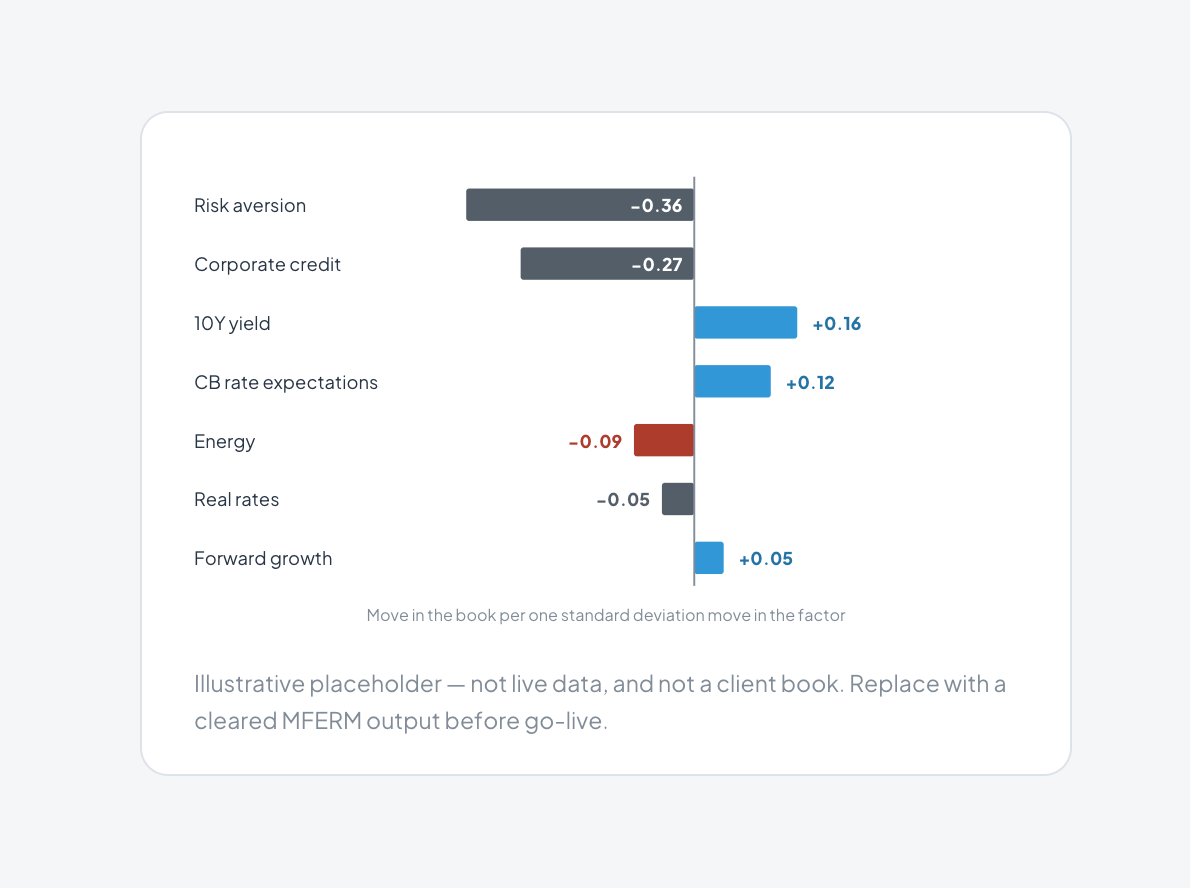
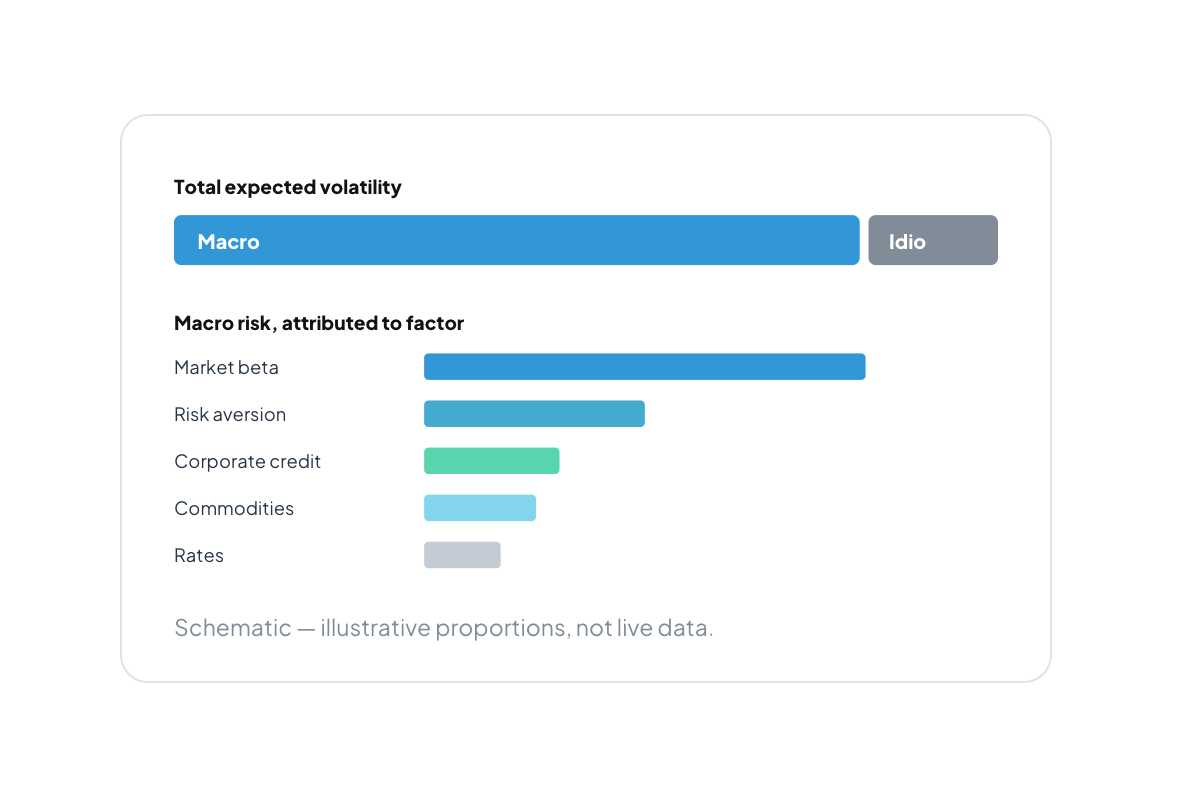
Total volatility divides into environment and company. Macro Share of Risk is the headline number, and it reads the same way for a single stock, a sleeve and a whole book.
Then it goes further. Market beta, risk aversion and credit typically account for most of the macro share, so you know which factor to act on rather than simply that macro is high.
Portfolio MSR is usually higher than any single name in the book. Idiosyncratic risk diversifies away. Macro does not.
A quarter goes badly and the allocator asks what happened. With the macro contribution invisible, the answer is a story — and nobody can tell a macro headwind from a broken process.
Exposure multiplied by factor move, linked daily, so the factor leg and the idiosyncratic leg sum to the total. It is entirely possible for the stock picks to have made money through a drawdown while the environment took more away.
The same split runs over any period: one day, one week, quarter to date, or a named episode.

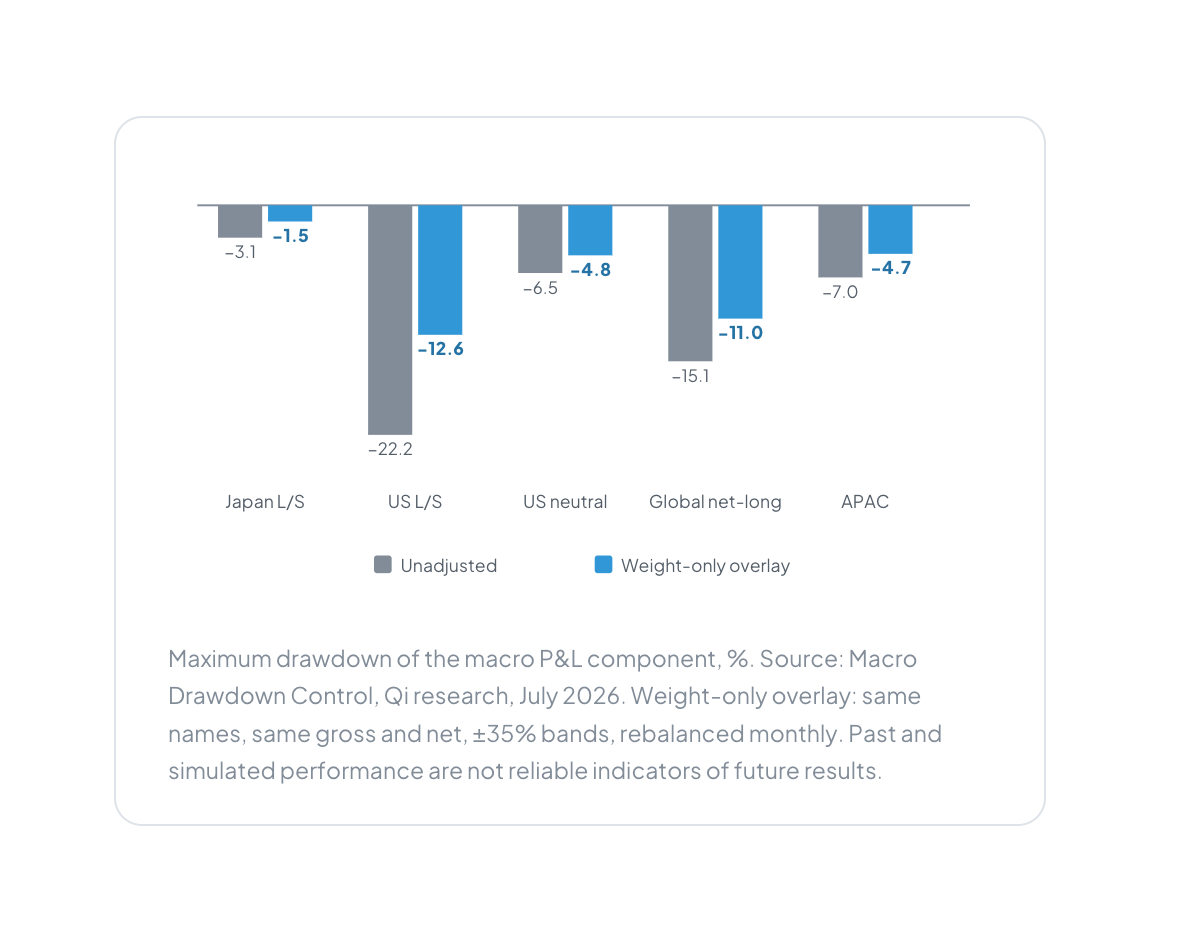
If most of a drawdown is the macro leg, the fix is not to sell the thesis. Weights carry the macro exposure, so weights are where it can be reduced.
Across five real equity books, a weight-only overlay — same names, same gross, same net, ±35% bands, rebalanced monthly — cut the maximum drawdown of the macro P&L component by 25–50% in every book, and improved 14 of 15 macro-led shock episodes.
The claim is about the macro leg only. What your stock picks do next is still your alpha.

Identify the macro exposures you never put on. Measure what they cost you, factor by factor and day by day. Act on them without changing a single name in the book.
If you have asked one of these questions and not had a satisfying answer, we built this for you.
Your existing risk model calls it residual. We show how much of that residual is macro — factor by factor, name by name — so you know which part of the book is genuinely yours.
Equity long/short
Separate stock selection from the rates, dollar and growth moves that carried the position anyway. Attribute the return to the decision that actually made it.
Equity long only
Stress the book against real macro shocks rather than synthetic ones. Quantify macro tail risk, and see crowding build before a regime shift forces everyone out at once.
Risk management & CRO
Track macro momentum across FX, rates, credit, commodities and equities, and see where price has pulled away from macro fundamentals.
Multi-asset & macro
Independent evidence that performance was generated by the strategy you described to allocators — not by a macro beta they are already paying for elsewhere.
Investor relations & due diligence
For family offices and wealth managers: systematic, rules-based indices, independently calculated and available to license — a macro alternative to passive allocations, without hiring a macro team to run it.
Family offices & wealth managers
Independent macro data and analytics for professional investors. Each is available on its own.
Published from the same live model that sits behind the products. Nothing here is hand-picked after the fact.